Art Newspaper Facebook Pac Pobric a Poverty of Feeling
The bright orange cover of Robert Storr'southward recently published collection of essays,Writings on Art 1980–2005, includes the names of 51 artists with seemingly fiddling in common: Martin Puryear, Sophie Calle, Art Spiegelman, Rachel Whiteread, and on and on. What brings them together—possibly the merely thing that could—is the famously pluralist sensibility Storr has cultivated over his long career.
The book, which is the first in a two-volume set (the second will re-publish essays from 2005 onwards), as well gives readers occasion to notice the ease with which Storr can move from generosity to bellicosity. On the ane hand, he is a charitable writer who enjoys the pleasures of cerebral artists (Adrian Piper), sensualists (Philip Pearlstein), and "archaeologists" (Louise Lawler).
But he is quick to denounce anyone he sees equally proscriptive (Clement Greenberg), self-indulgent (Frank Stella), or imperious towards public opinion (Richard Serra). Today, as many critics bite their tongues out of fear of popular reprisals, concerns about professional person liability, or an outright lack of conviction, Storr is all the same taking shots at fellow writers and former friends like Peter Schjeldahl, whom Storr sees as a clear failure.
Nosotros spoke with Storr on the occasion of the new book well-nigh the inadequacy of art theory, why critics shouldn't trust their own gustation, and why modern fine art is not a relay race.
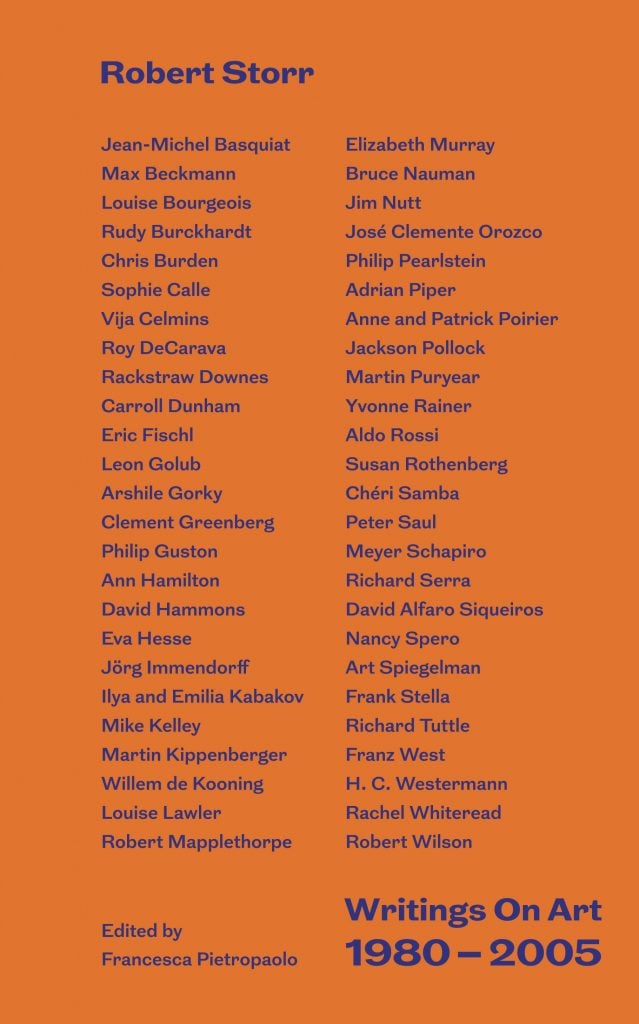
Let's begin with the process of putting this book together. It covers 25 years of writings and quite a broad range of artists. What themes exercise you see running through?
1 of the themes is the broad array. I've always felt that the writing of art history and art criticism in [the United States] has been tendentious and ideologically narrowing. And then I thought the first thing to do was simply to set up the precedent for writing that was abrupt and focused, yet didn't attempt to funnel everything into a big idea. I think in that location's a point at which the record owes artists, merely particularly fine art, some liberty from the controlling ideas of the critic.
There's a quotation from Baudelaire that says: "Similar all my friends, I take tried more than in one case to lock myself inside a system, so to pontificate every bit I liked. But a system is a kind of damnation that condemns us to perpetual recidivism: we are ever having to invent another, and this is a cruel form of penalization." I kept having to revise my theory, so rather than going through that feel over and over, I resolved not to have 1.
In fact, a lot of these essays were written at the summit of the "theory wars" of the 1980s and 1990s. Some critics said philosophy—and specially French philosophy—was essential for interpreting art, while others resisted that idea. Those battles seem to accept subsided at present, simply what did we win or lose in those fights?
I was partially educated in France. I'g fluent in French and I read a lot of critical theory in French. I give it some acceptance overall. I am not anti-theory. But I don't think we're done with that particular intellectual or aesthetic evolution. I have so many students walking effectually mouthing statements that are simply handed down from the previous generation. The debates are non hot and heavy now, just their effects are deep and profound. And that's precisely because the October oversupply [of art historians] and others got away with hell.
Most of them didn't know whatever art history, or not much, and they proceeded to blame and shame artists who didn't fit their categories for reasons that were ostensibly about larger political realities that they had misunderstood. And they stayed very safely within the boundaries set by formalism in the 1960s and '70s. What I exercise is just get out in that location and look and effort to learn as much I can. That is a really simple proffer. That's not a theory, information technology'southward a practise.
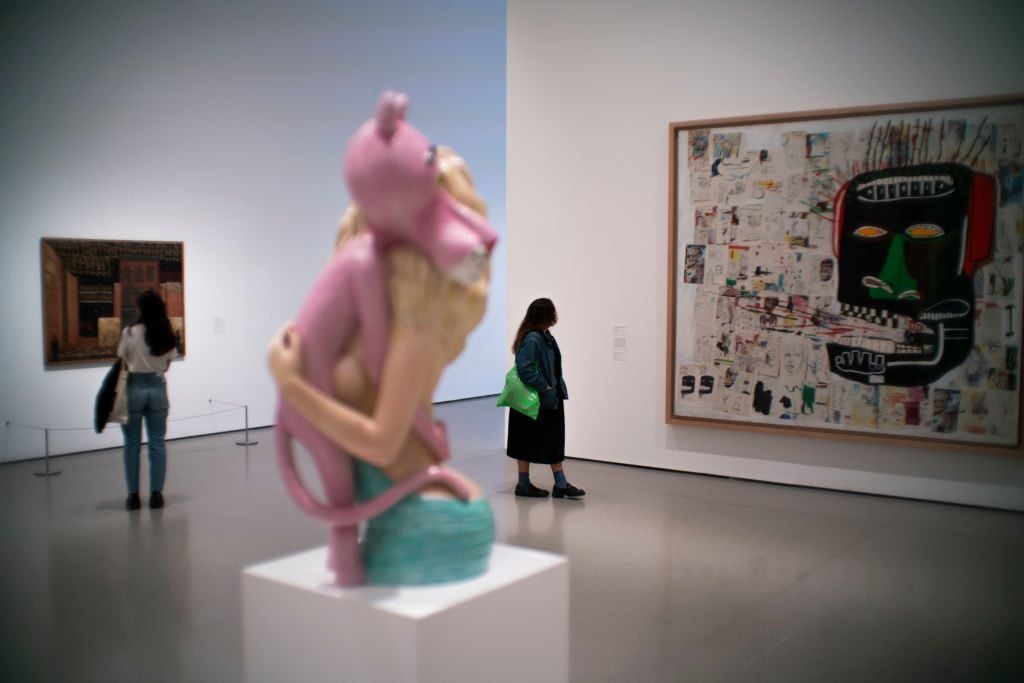
Artworks at the Museum of Modern Art in New York. Photograph by Eduardo MunozAlvarez/VIEWpress/Getty Images.
In that location are critics who say information technology'due south impossible not to take some theory, because y'all already have one, even if you don't acknowledge it. At that place is always some implied lens through which yous're looking. How exercise you respond to that?
A lens is not a theory. A theory is a arrangement of ideas; a lens is the recognition that you encounter things with certain kinds of biases. You lot cannot analyze things without focusing and filtering. I acknowledge that. But I too think that if i is a scrupulous writer, i tin adjust lenses and choose them with care.
What'south the bespeak of intellectual discourse if y'all tin't contend with yourself? One of the thinkers that has influenced me a lot is [the Russian literary critic] Mikhail Bakhtin, who talks about all literature being a chat amidst the unlike dimensions of the writer'southward personality. That's what I do. I contend with myself. A lot of the arguments have to practice with the value of what I was writing about.
What about taste? Do yous call back virtually that when you're writing?
I think most it a lot and I am distrustful of it e'er, my own and other people's. I retrieve gustatory modality is essentially a conservative factor in art. Be that as it may, I exercise have things to which I'm alarm, or things to which I reply, if you want to call that taste. That's the point where my particular experience equally a museum curator plays in, because I would have to argue for things that collectors constitute distasteful. Over and over, I had to say to them, "We're hither to judge the importance of works of art, not whether or not we want to live with information technology. Therefore, do non make your tastes or my sense of taste the criteria for what goes into the museum. Make the importance of the work your criteria."
Let's talk about that. You worked at MoMA in New York for 12 years, starting in 1990. How did that play a office in these manufactures, some of which were written equally catalogue essays? Do curators working inside institutions accept a sure proximity to artworks that critics don't?
Absolutely, and there'southward a lot to exist unpacked here. First of all, the Museum of Mod Art is non a museum. Information technology's a projection. It has acquired and exhibited things equally a event of this project. Knowing that tastes evolves, knowing that collections are disparate—that's hugely important when you lot're writing criticism because information technology reminds you that, in fact, there was no consensus. In the past, there were many competing forces. I used to say, as you get through [MoMA's] collections, you should hear rumblings in the rooms because each one is devoted to i suggestion about what modern fine art should be, and they all disagree with each other. Formalism, under Greenberg and under [former MoMA chief curator of painting and sculpture] Neb Rubin, tried to streamline it and say information technology was all part of the aforementioned matter. It is absolutely not.
I did a show at MoMA called "Modern Art Despite Modernism" that made the case that within the building are all the "also-rans" for being the definition [of modernism]. Some of them are very compelling and important. They're not just the losers. They are the ones that didn't win, just they're not the ones that didn't compete. That is the true history of mod art. Information technology's a debate well-nigh what modern art should be. The consensus that Greenberg keeps summoning is a fiction, and should not be treated as anything simply. It'due south as well anti-democratic. It shuns some art and discourages independent looking at things that are puzzling. And the one thing all modernistic fine art should exist is puzzling, right? [Greenberg] takes away from viewers that moment of non knowing, and tells them they should automatically know that this is better than that.
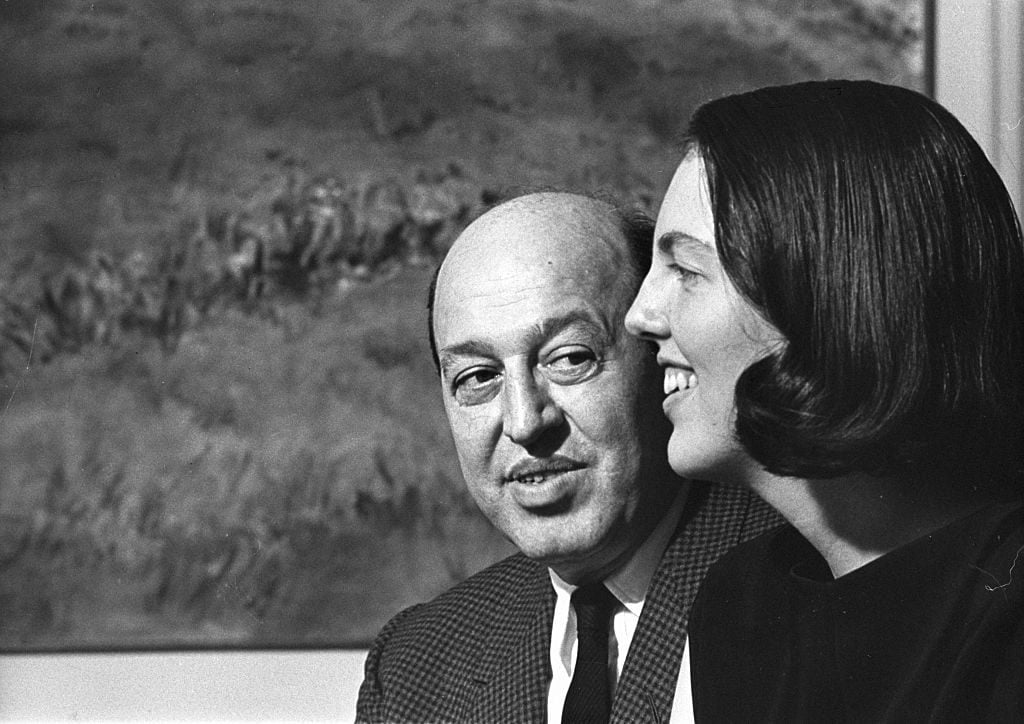
Cloudless Greenberg with his married woman, Jenny. Photo past Hans Namuth/Condé Nast via Getty Images.
One matter that stands out almost Greenberg is the certainty with which he issues his verdicts, and your essays are also written from a position of conviction. How practice yous prevent yourself from going too far?
Self-discipline. I take stiff convictions, but I accept absolutely no certainties. So I make an argument for something and I am convinced that the argument is good and then far as it goes. But the important affair is not to push it past the point that it applies to what you're talking most.
There's a quote at the beginning of the catalogue for "Modern Art Despite Modernism" by [the Portuguese author] Fernando Pessoa, who had dissimilar pseudonyms—heteronyms, he called them—in his writings. He had multiple personalities, and wrote both as a critic and as a poet, and each poet and critic had a different identity. The quote is: "One God is born. Others dice. Truth/Did not come or go. Error changed."
Pessoa is a model of a pluralistic individual performing at a very high level. And if you recollect of each "ism" as the assertion of an interesting proposition and also the nascence of a new error, you're better off than if yous think information technology is the truth that supersedes previous truths.
Permit's talk more about museums. They're in the midst of a reckoning right now, having to accommodate concerns about the catechism and sensitivities effectually the artists and fine art they evidence—I'm sort of dancing around the postponement of the Philip Guston testify at the National Gallery of Art. What part should institutions play in navigating these concerns?
They should be the forum for those debates. They should not exist trying to pussyfoot with them, they should really be the place where they take place. I remember museums are ideal for that, and I think the more dissonance, the better. I know people call up that'south naive, merely don't tell me I'm naive having worked for as long as I did at MoMA. I know what the restraints on museums are. I know trustees, I know the ability of ideologies. Gimme a break. The speed with which the curators at the National Gallery caved is not an indication of whether it'southward possible, only whether they take courage and guts, whether they are willing to risk their positions. [Curator] Mark Godfrey at the Tate stood upwards for his beliefs, and he got clobbered. Simply he stood upwardly for them and that's to his credit.

A visitor looks at Philip Guston'due south Riding Effectually in the Falkenberg in Hamburg. Photo by Bodo Marks/motion-picture show alliance via Getty Images.
Did you see Peter Schjeldahl's take on the whole thing? He basically second guesses the art-world consensus that the postponement was unwarranted.
Peter was the person who introduced me to professional person art writing, and he was a very good friend for a long time, and and so he became a very bad friend subsequently. I have nothing but disappointment in Peter's behavior in the last 20 years. He has retreated into an e'er smaller, more taste-based, more than capricious definition of what is legitimate. And he's also turned himself into a kind of a libertarian. He has politics—although he says he doesn't—and he believes basically that art is for those who are lucky enough to have some. He was all set to sell the drove in Detroit for idiotic reasons that I think fifty-fifty Ted Cruz would be embarrassed past. That's what Peter does. He makes farthermost statements, gets caught up in them, apologizes, and thinks all is forgotten.
The point is, he has no binding principles of conduct. I'm non talking virtually ideological or aesthetic ones. He has no sense of professional person conduct. He excuses every excess that allows him to write a flashy article and I think that's diminished his criticism massively. He was actually good at cartoon unexpected connections and he has an enormously gifted style with words. But Peter'due south problem was that he started being declarative. He was saying that he was the near daring and near free individual in the game. He wasn't free at all. And he couldn't acknowledge the ways in which he wasn't free. He is afraid of ideas to the betoken that he can't be skilful critic.
Speaking of politics, yous've said before that yous're a lapsed Marxist. Are you reassessing whatever of your one-time politics lately?
I've thought near it a great bargain. Part of me says, "Rob, you actually should take gone hardcore and only become a militant." But what beset me in the 1970s, when I was very close to making that conclusion, was that I had friends who were so dogmatic and so disparaging of art and and then vicious to me personally, that I only walked away from it. I felt that oestrus and I've seen those people become ideological and I don't desire to accept anything to do with it. I also distrust academic Marxists because they take never done any real politics at all, so they don't know that danger. I don't believe in lining upward the oligarchy along a wall and shooting them. I don't believe in the land taking everything and doling it out to whomever. I am a failed Marxist in that sense, likewise: I am not willing to exercise the extreme things that sure branches of Marxism think is necessary. I only won't do it.
All things considered, would yous say you feel politically optimistic right now, or pessimistic?
You know the formula of [the Italian Marxist thinker] Antonio Gramsci? "Pessimism of the intellect, optimism of the will." I think things are very dire. I did not anticipate the degree to which the world was fragile, and Trump basically provided the evidence that it was. Somebody else is going to come along and clarify the scraps and put them together in a horrifying style. But I don't think that means our window is closed. One of the things we have to do is finish the ideological "I'm correct and you're wrong" discussions. We have to endeavour to figure out how to build coalitions. Those are the just ways to salve this country, because [the US] was in fact a coalition from the start. Most positive movements in political history have been coalitions, not ideologically pure tendencies.
Follow Artnet News on Facebook:
Want to stay ahead of the art world? Subscribe to our newsletter to get the breaking news, eye-opening interviews, and incisive disquisitional takes that drive the conversation forward.
Source: https://news.artnet.com/art-world/robert-storr-interview-writings-on-art-1938044
0 Response to "Art Newspaper Facebook Pac Pobric a Poverty of Feeling"
Post a Comment